Wednesday, September 28, 2011

Re-Skilling with Natural Dyes

Last weekend I went on a road trip to Santa Cruz for the Permacouture Institute. We were asked to present at the Re-Skilling Expo, a day long event dedicated to education around all sorts of "lost" arts (think- beekeeping, making home remedies, fermenting, dehydration, natural building, etc...)
It was a great event and so fun to teach natural dyes with Sierra Reading, a textile student at CCA. 


Just a sampling of our brilliant show & tell: onion skins and avocado pits ready for the dye pot, red sandal wood dye & a homemade iron bath. Sierra's beautiful samples of onion skin, safflower and olive dyes.


Sierra showing off our colorful table display. Turmeric dyed prayer flags, Sierra's masterpiece of natural dye screenprinting using purple cabbage. And our dye vats for the afternoon workshop beginning to simmer...


nasturtium presses, black bean dye, and samples from colors made in India earlier this year.


Apple Leaves and Eucalyptus leaves, both harvested from the Permaculture Garden at Merritt College (Was able to take the leaves after a pruning demo)


We had to modify the schedule to give ourselves a 15 minute breather in between sessions!


The spectacular color of Fall's eucalyptus.


                                                                   Hanging up our colors.
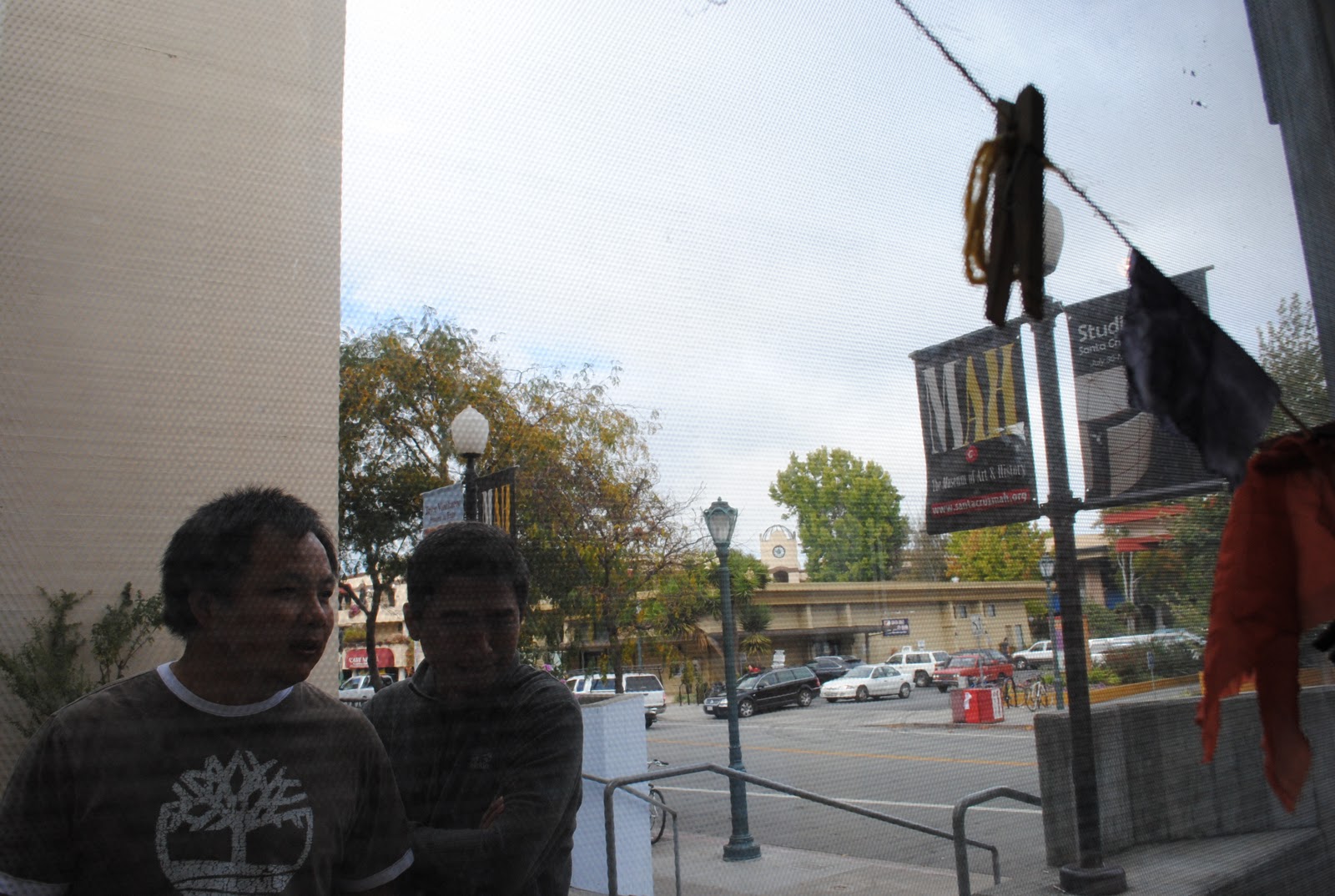

          I loved the passers- by who peeked through the window to amaze at these colors from nature!


                                                      Fig leaves offering a golden yellow


It was a wonderful day in Santa Cruz. Had to make a visit  to the beach while we were there for a quick hello! 

Monday, September 26, 2011

Slow Food Sangati


On Saturday, September 17 The Sangati Center participated in the $5 Slow Food Challenge - A national event encouraging folks to prepare a healthy, local and organic meal to prove that good food does not have to be expensive.

All of our ingredients came from the Berkeley Farmer's Market. We served 50 dinners at a $5 donation/plate

Our all organic menu:

Market Salad - Happy Boy Farms greens - wild arugula, baby spinach, little gems, and salad mix, Purple Cherokee heirloom tomatoes, Kashiwase Orchards 'September Sno' peaches, Frog Hollow Farm cold press extra virgin olive oil, home grown meyer lemon, Tercera Farms shallots.

Main - Massa Organics California brown rice, freshly shelled Tercera Farms heirloom cranberry beans, oyster and shitake with garlic, Full belly farm walnuts

Sweet- Rose Geranium scented strawberries from Lucero farms with black mission figs.

After the meal, of course, there was a beautiful concert presented by the Sangati Center and performed by Mohanrangan Govindraj on the bamboo flute. We had over 75 guests at the concert.

What a perfect evening.

Thanks to the Subterranean Art House in Berkeley for hosting our event and my loyal friends and event volunteers - Josh & Jaia, Zarah and Christine.


Saturday, September 3, 2011

every now and then opportunity arises.


As one of our wedding gifts we were given a juicer, an amazing juicer! This thing has become G's soulmate. When we packed all of our things into storage and headed off to India, he made sure that the juicer was clearly labelled and easily accessible so that whenever we came back it would be front and center in our kitchen. And it is. In our tiny kitchen with just two counters, the juicer has one all to itself. But I cannot complain. Having fresh juice daily is truly invigorating and nourishing! Carrot, Apple, Ginger is the house special, but every now and then we add celery and beets to the mix. The other day we made beet juice and when we went to clean out the juicer (by the way the fiber left over from the juicing process is wonderful in quick breads and muffins!) we found this perfectly carved beet just waiting to be stamped. The natural color of the beet transfered beautifully to my envelopes. Luckily I had just picked up a stack of lovely envelopes (10 for $.25) at my neighbor's garage sale. Beets are often mistaken for natural dye, when in fact, they are a stain. The color rests only on the top layer of fabrics and does not bind to the fiber as a whole, resulting in a color that fades to brown over time. But, the beet with its deep deep magenta hue makes a perfect candidate for stamping.


Thursday, September 1, 2011

Amaranth: Stacking Functions Left and Right.


You may have read an earlier short post I published on the wonder grain amaranth. But I thought I would post again, as I've discovered an absolutely wonderful use of the grain... in sushi:

Homemade sushi: amaranth, cucumber, carrots, fresh ginger, tempeh and shitaake.

You can prepare the amaranth by simply boiling 1 part amaranth to 1.5 parts water. I let the grain boil for about 10 minutes, then I keep stirring until finished to acheive a creamy texture. For the sushi "rice," I added a bit of rice wine vineger and a touch of demerara sugar to the cooked grain for a bit of added flavor. Rolling your own sushi is incredibly easy. It was my first attempt, and I am now a complete convert. Never again a sushi out at a restaurant! I always have either cooked rice in the fridge or amaranth in the pantry. We stock carrots because we love making fresh carrot juice in the juicer. And just about any vegetables work for the filling. And one packet of Nori (seaweed sheets) has about 10 sheets, so the packet I purchased yesterday should last for a while.

Amaranth growing prolifically in the UCBG Crops of the World Garden

Amaranth (Amaranthus sp. ) is truly a wonder plant. It has been grown and used as a food source for some 7,000 years! The seeds have been used all around the world as a grain that serves as a complete protein, a source of fiber and minerals. When we were in India it was available and we used the grains to replace rice, to make chapattis and to make more wholesome dosas and idlies. The grains are gluten-free. They were a staple food of the Incas, who called it "kiwicha" and who also popped the small grains and mixed them with honey to make a sweet candy called "Alegria," which by the way means "joy" in Spanish. Amaranth was also eaten by the Aztecs who called it "huautli"

The plant itself is easy to grow, provides thousands of seeds/grains per plant, and the seeds themselves are easy to cook requiring little water, and not much fuel to do so.

The leaves are also highly nutritious and are consumed across many cultures in Africa and Southeast Asia.

In North America, amaranth was used by the Hopi as a natural dye as a brilliant source of deep red. This particular species of amaranth now carries that name, 'Hopi Red Dye' (Amaranthus cruentus or Amaranthus cruentus x A. powellii)

Amaranth is easily grown in our Bay Area climate. The grains are also available at most grocery stores or natural food stores. For my friends across the country and in between, Whole Foods is a reliable source of Amaranth grains. I encourage you all to try it out! And if you already have, try it in a new way, replacing rice, adding loosely cooked grains to salads, making Alegria, or....


Sunday, August 21, 2011

oh how i love when you get to eat flowers!


today i got inspired at the temescal farmer's market when i saw some beautiful squash blossoms at happy boy farms. i've always wanted to make stuffed squash blossoms, but just felt like they were too complicated and hard for me.

so i just went for it and decided today was the day. the nice woman at the stand gave me the encouragement i needed. (it didn't hurt that the organic blossoms were 10 for $1.00!!)

i hopped over a few stalls and visited cowgirl creamery where i picked up some delicious fromage blanc to stuff them with.

the whole process was so simple. i washed the blossoms and allowed them to fully dry on a paper towel. then i stuffed each little blossom with about a spoonful of fromage blanc, while i heated some olive oil in a skillet (i didn't do a deep fry, but rather a pan fry). i prepared a batter using flour, water and seasalt.

i also roasted some padron peppers to go along with. these are my favorite summer find. simply delicious broiled with a lil olive oil and sea salt.


another happy boy find was the Piel de Sapos melon. mmm mmm mmm so sweet!!


Saturday, August 20, 2011

DIY Indian weddings are possible.

I'm just back from two weeks in Findlay, Ohio, The place where my sister and I grew up. She got married there last week. I was asked to do the arrangements for the centerpieces as well as make the flower garlands that are used ceremoniously for the hindu wedding ceremony. It was a bit of a challenge to find local, organic flowers, but I did my best. I worked with a local florist and we were able to find some local options to mix in with the not-s0-local. My sister's good friends also grew some of the flowers and foraged locally for wildflowers to mix in as well.

Another important aspect of the ceremony is the Mandapam. This is the 4 postered structure that the ceremony takes place in. It is meant to represent the couples' first home. I constructed the mandapam from black bamboo and adorned it with the traditional mango leaves, banana plants, and handmade fabric vilva garlands.

I'm thinking I might get into the business of Handmade South Indian weddings, any takers?

Here are a few pics of the arrangements and the garlands!

Mum, carnation and rose garlands.

Goldenrod, Aster, Alstroemaria, Sunflowers and Red Roses. For the vases I collected old tin cans and wrapped then in hand stamped kraft paper with twine.


Thursday, August 18, 2011

what's growing in findlay ohio

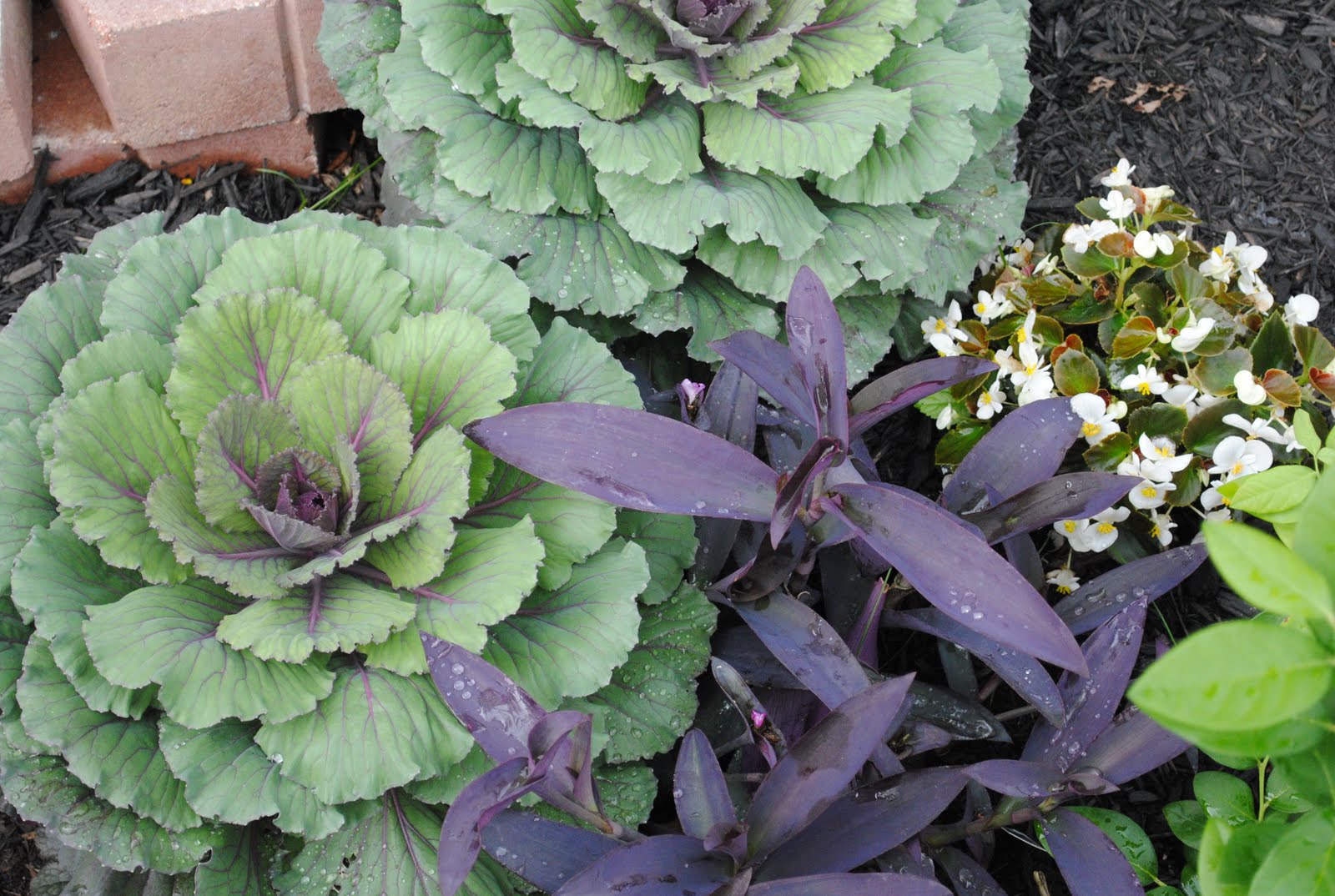
ornamental cabbages

yarrow

floriforous jasmine!

brightly colored coleus


Sunday, August 7, 2011

these flowers will never fade


this week, we're preparing for my sister's wedding here in findlay, ohio. you might remember these pretty fabrics that i picked up in chennai earlier this year. well we are in full swing and have made 177 fabric flowers for all of the wedding guests as favors and festive adornments! there are roses, dahlias and poppies in an assortment of corsages, pins, and hair clips. i love the dahlias best.

the yellow accents and flower were dyed with turmeric!

enjoy!

Tuesday, July 19, 2011

Nectarine Sherbet


A few days ago I tried out this oh-so-simple nectarine sherbet recipe from my friend at Yummy Supper and it came out sooooo YUM!

I'm sure it can also be adapted for all the other stonefruits in season now!


Monday, July 18, 2011

Richmond Grows & Dyes!

The surprise of the day - Avocado pits!

Our cold turmeric dye bath

Participants preparing their samples using Shibori techniques

Showing the homemade Iron mordant

"How many of you love plants!?"

I am so happy after a successful workshop. The feeling of inspiring others with the colors of natures is so satisfying and enjoyable. Thank you to all the participants of Permacouture Institute's first Seeds to Sew workshop at the Richmond Public Library this Saturday. And huge thanks to Rebecca Newburn for organizing and starting the Seed Library there.

I'll be teaching another introductory natural dye workshop outdoors at the Berkeley Eco House on August 27th - Hope to see you there!


Friday, July 15, 2011

Fennel Dye


In preparation for tomorrow's workshop at Richmond Grows I started a fennel dye today. Yesterday as I was out and about picking up some rusty objects (post on that coming soon) when I saw a nice clump of fennel growing in the parking lot. After asking I harvested a bunch and brought it home with me.

Today I threw the leaves and flowers into a 5L glass jar and poured hot water over the leaves. I'll let this steep and stew overnight and tomorrow during the workshop we'll boil up the leaves with our fibers.

With so much fennel growing everywhere, this makes sense as a wonderful dye for our area. But, always be sure to ask the landowner before you go out with your clippers. Another very important point is that this plant, though introduced and invasive, is a very important habitat species. It is the host plant for the Anise Swallowtail butterfly. After checking in with the land-owner also be sure to avoid harvesting caterpillar eggs along with your dyestuff.


Wednesday, July 6, 2011

Seeds to Sew: Tagging Dye Plants at the Richmond Seed library

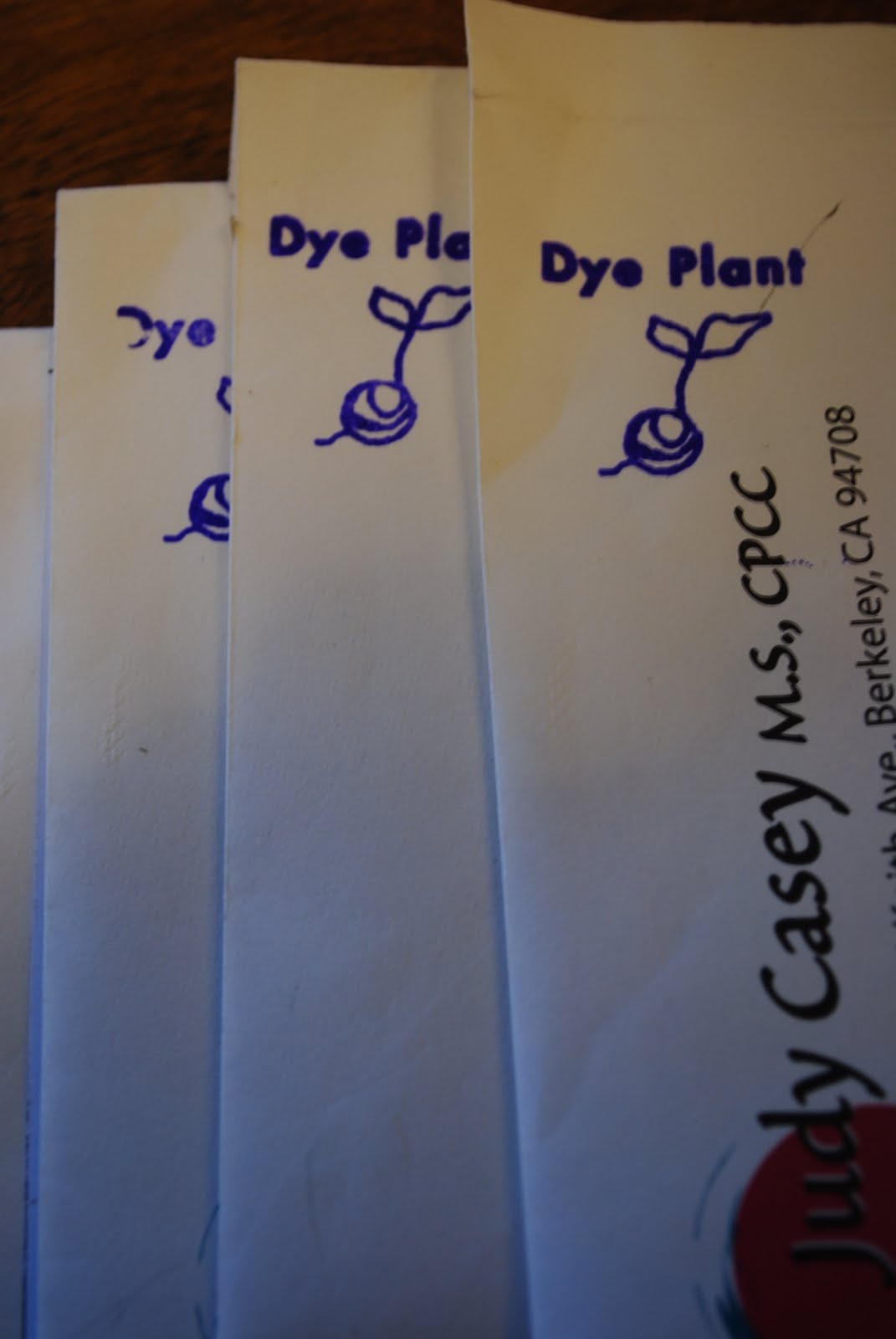
Last month, with the Permacouture Institute, we launched our "Seeds to Sew" project at the Richmond Grows Seed Library. Yesterday I went over to the library and got to use the nifty new stamp we made to tag seeds.

This logo indicates that a seed in the library has natural dye properties and encourages you to grow dye plants and begin creating beautiful colors from nature. There are helpful plant lists and natural dye recipes available at the library.

And on Saturday July 16th I'll be teaching an introductory workshop on getting started with natural dyes at the library from 1pm-3pm. You can sign up here