Showing posts with label natural dye. Show all posts

Saturday, September 3, 2011

every now and then opportunity arises.


As one of our wedding gifts we were given a juicer, an amazing juicer! This thing has become G's soulmate. When we packed all of our things into storage and headed off to India, he made sure that the juicer was clearly labelled and easily accessible so that whenever we came back it would be front and center in our kitchen. And it is. In our tiny kitchen with just two counters, the juicer has one all to itself. But I cannot complain. Having fresh juice daily is truly invigorating and nourishing! Carrot, Apple, Ginger is the house special, but every now and then we add celery and beets to the mix. The other day we made beet juice and when we went to clean out the juicer (by the way the fiber left over from the juicing process is wonderful in quick breads and muffins!) we found this perfectly carved beet just waiting to be stamped. The natural color of the beet transfered beautifully to my envelopes. Luckily I had just picked up a stack of lovely envelopes (10 for $.25) at my neighbor's garage sale. Beets are often mistaken for natural dye, when in fact, they are a stain. The color rests only on the top layer of fabrics and does not bind to the fiber as a whole, resulting in a color that fades to brown over time. But, the beet with its deep deep magenta hue makes a perfect candidate for stamping.


Thursday, September 1, 2011

Amaranth: Stacking Functions Left and Right.


You may have read an earlier short post I published on the wonder grain amaranth. But I thought I would post again, as I've discovered an absolutely wonderful use of the grain... in sushi:

Homemade sushi: amaranth, cucumber, carrots, fresh ginger, tempeh and shitaake.

You can prepare the amaranth by simply boiling 1 part amaranth to 1.5 parts water. I let the grain boil for about 10 minutes, then I keep stirring until finished to acheive a creamy texture. For the sushi "rice," I added a bit of rice wine vineger and a touch of demerara sugar to the cooked grain for a bit of added flavor. Rolling your own sushi is incredibly easy. It was my first attempt, and I am now a complete convert. Never again a sushi out at a restaurant! I always have either cooked rice in the fridge or amaranth in the pantry. We stock carrots because we love making fresh carrot juice in the juicer. And just about any vegetables work for the filling. And one packet of Nori (seaweed sheets) has about 10 sheets, so the packet I purchased yesterday should last for a while.

Amaranth growing prolifically in the UCBG Crops of the World Garden

Amaranth (Amaranthus sp. ) is truly a wonder plant. It has been grown and used as a food source for some 7,000 years! The seeds have been used all around the world as a grain that serves as a complete protein, a source of fiber and minerals. When we were in India it was available and we used the grains to replace rice, to make chapattis and to make more wholesome dosas and idlies. The grains are gluten-free. They were a staple food of the Incas, who called it "kiwicha" and who also popped the small grains and mixed them with honey to make a sweet candy called "Alegria," which by the way means "joy" in Spanish. Amaranth was also eaten by the Aztecs who called it "huautli"

The plant itself is easy to grow, provides thousands of seeds/grains per plant, and the seeds themselves are easy to cook requiring little water, and not much fuel to do so.

The leaves are also highly nutritious and are consumed across many cultures in Africa and Southeast Asia.

In North America, amaranth was used by the Hopi as a natural dye as a brilliant source of deep red. This particular species of amaranth now carries that name, 'Hopi Red Dye' (Amaranthus cruentus or Amaranthus cruentus x A. powellii)

Amaranth is easily grown in our Bay Area climate. The grains are also available at most grocery stores or natural food stores. For my friends across the country and in between, Whole Foods is a reliable source of Amaranth grains. I encourage you all to try it out! And if you already have, try it in a new way, replacing rice, adding loosely cooked grains to salads, making Alegria, or....


Monday, July 18, 2011

Richmond Grows & Dyes!

The surprise of the day - Avocado pits!

Our cold turmeric dye bath

Participants preparing their samples using Shibori techniques

Showing the homemade Iron mordant

"How many of you love plants!?"

I am so happy after a successful workshop. The feeling of inspiring others with the colors of natures is so satisfying and enjoyable. Thank you to all the participants of Permacouture Institute's first Seeds to Sew workshop at the Richmond Public Library this Saturday. And huge thanks to Rebecca Newburn for organizing and starting the Seed Library there.

I'll be teaching another introductory natural dye workshop outdoors at the Berkeley Eco House on August 27th - Hope to see you there!


Friday, July 15, 2011

Fennel Dye


In preparation for tomorrow's workshop at Richmond Grows I started a fennel dye today. Yesterday as I was out and about picking up some rusty objects (post on that coming soon) when I saw a nice clump of fennel growing in the parking lot. After asking I harvested a bunch and brought it home with me.

Today I threw the leaves and flowers into a 5L glass jar and poured hot water over the leaves. I'll let this steep and stew overnight and tomorrow during the workshop we'll boil up the leaves with our fibers.

With so much fennel growing everywhere, this makes sense as a wonderful dye for our area. But, always be sure to ask the landowner before you go out with your clippers. Another very important point is that this plant, though introduced and invasive, is a very important habitat species. It is the host plant for the Anise Swallowtail butterfly. After checking in with the land-owner also be sure to avoid harvesting caterpillar eggs along with your dyestuff.


Wednesday, July 6, 2011

Seeds to Sew: Tagging Dye Plants at the Richmond Seed library

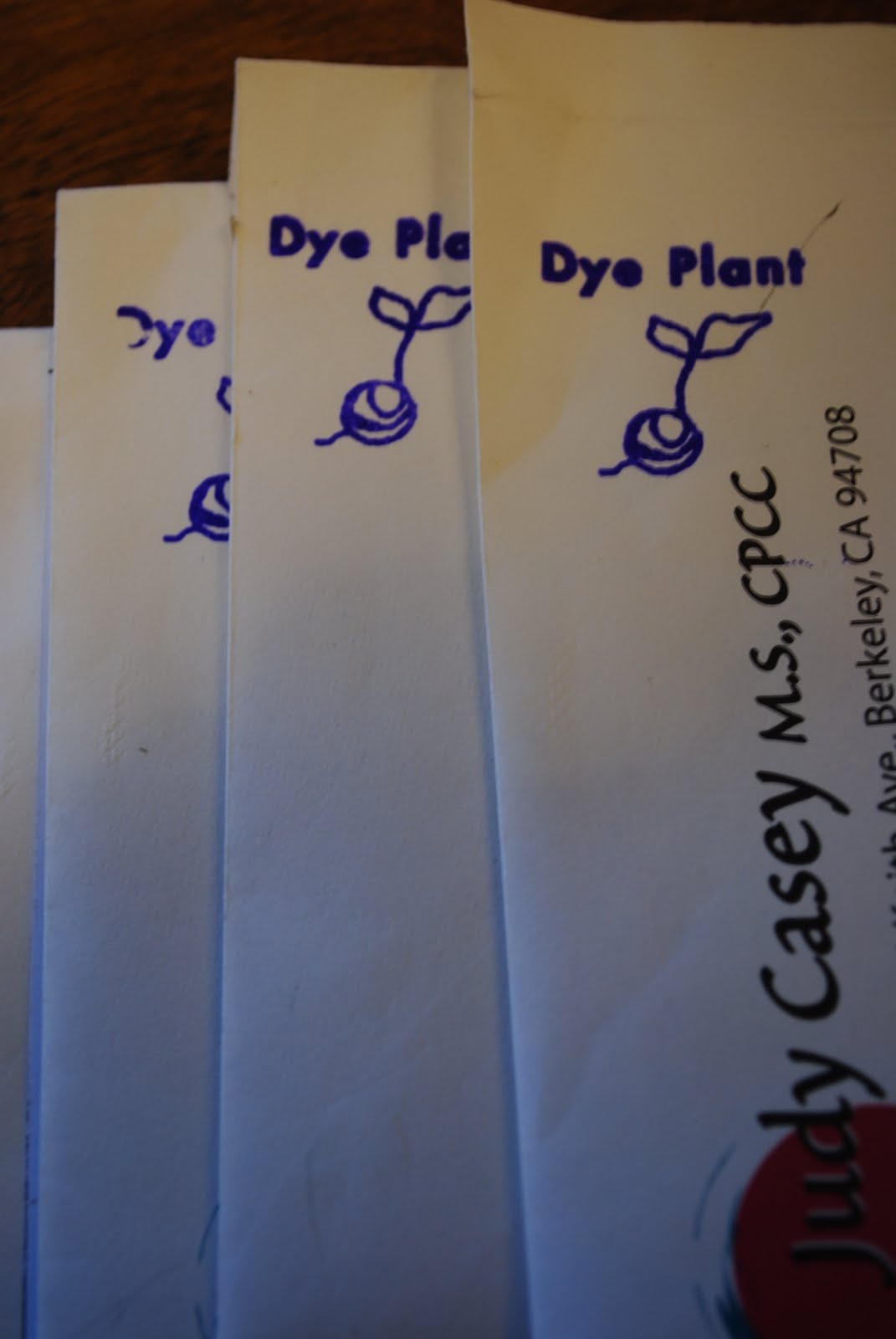
Last month, with the Permacouture Institute, we launched our "Seeds to Sew" project at the Richmond Grows Seed Library. Yesterday I went over to the library and got to use the nifty new stamp we made to tag seeds.

This logo indicates that a seed in the library has natural dye properties and encourages you to grow dye plants and begin creating beautiful colors from nature. There are helpful plant lists and natural dye recipes available at the library.

And on Saturday July 16th I'll be teaching an introductory workshop on getting started with natural dyes at the library from 1pm-3pm. You can sign up here

Sunday, March 27, 2011

natural dyes at the organic mela, chennai


Last week I was a part of a wonderful "organic mela" put on by the Safe Food Alliance and ReStore Chennai. the mela (festival) was held in the Semmorzhi Poonga, the new park in central Chennai. It was a hot Saturday afternoon and there were hundreds of people who were coming through. The various booths included information on GMO, pesticides, local varieties of rices, and vendors selling organic groceries and handloom, organic cotton shirts. There was delicious food and the most refreshing drink made from organic palm sugar and lime juice.

I hosted a small table on natural dyes. We showed off some of the beautiful samples made by a friend highlighting local sources of plant dyes. I prepared a cold turmeric bath and those who came by made a little textile from the bright yellow color. I believe that we raised awareness about textiles and the abundance of local sources for beautiful color. It was an inspiring day for me and I am very thankful for the opportunity!

To see more photos visit this link

Thursday, February 3, 2011

onion skins


onion skins. they have got to be on the top dye list for me as they yield a glorious glowing gold AND most importantly, they are a perfect by-product dye. most of us use onions on a regular basis in the kitchen. what i do is keep a glass jar on top of the refrigerator and as time goes just add my skins to the jar, when its full its time to dye! one thing just to make sure is that you leave any of the fleshy bits out of your jar - they will decompose soon and add moisture and rot to your other skins!

Tuesday, February 1, 2011

Five-Leaved Chaste Tree : Vitex negundo or Nochhi


A new discovery, which yielded at beautiful green is the plant Vitex negundo (Tamil "Nochhi," English "Five Leaved Chaste Tree"). This plant is a member of one of my favorite plant families the Lamiaceae - a family that includes salvias and most of the fragrant culinary herbs - lavender, basil, mint, thyme, etc...

We prepared the dye bath by boiling up water and adding a nice big bunch of Nocchi leaves. We added our pre-mordanted raw silk and handloom cotton.

If you add soda ash to the dye bath - the color should be a more teal-turquoise ish blue green.

Monday, January 31, 2011

Pomegranate (Punica granatum)


pomegranate is certainly one of my favorites fruits. its deep red color and juicy gems within are so refreshing and healthy. this ancient plant is native to iran and northern india and is widely cultivated in the mediterranean, india and tropical africa. if you've ever wondered how many seeds a pomegranate has within - guess no more, the average among varieties is 613!

pomegranate skins are a great by-product dye. we collected ours from a local juice shop, by just asking for their left over peels. i set the fresh skins out in the sun to dry for a day, then we boiled them up with water, submerged our mordanted fabric and voila! a gorgeous reddish brown!

Sunday, January 30, 2011

garden garments in chennai


hi folks! i got lots of great photos to share from our two part natural dyeing workshop held in chennai last week. the word was put out to the reStore Chennai listserve, and there was a great response. the workshop was full of ten lovely ladies (and one little lady named isha), who each brought something beautiful to the table. our colors were vibrant. inspiring two days for all!! i'm going to break up my posts by each color that we used, starting with turmeric, a classic. happy dyeing!

turmeric/manjal dye


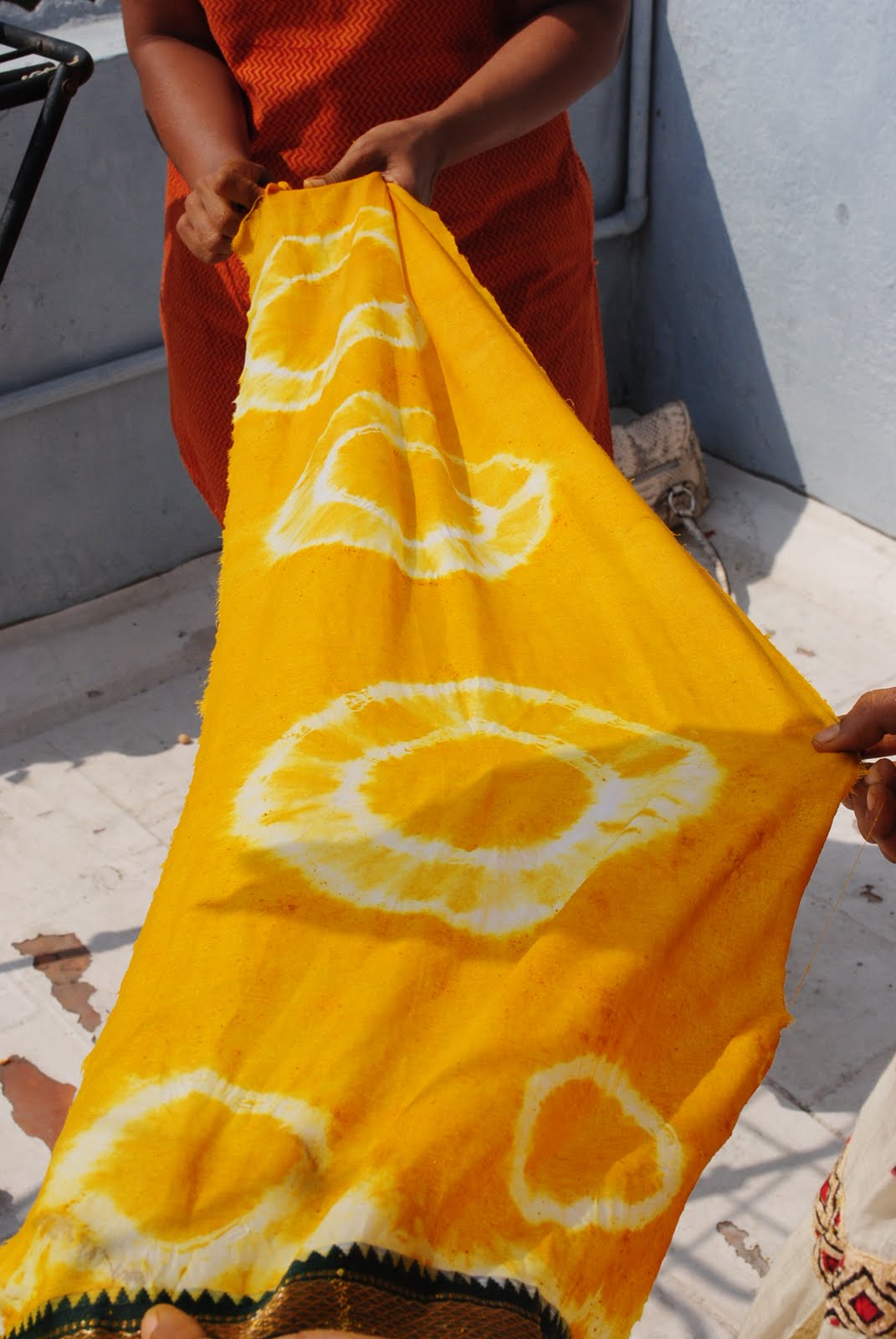
probably the easiest of all the dyes is turmeric. especially in india, where it is so abundant. turmeric is one of the few dyes that you can prepare in a cold bath - no energy is needed to heat the dye stuff. we simply put 100 grams of turmeric powder in this bucket of cold water. used rubber bands to create resist patterns and then dropped our cloth inside. we left our fabric overnight, just to soak in the color. no mordant used on this cotton, which was actually an old veshti!

Monday, January 24, 2011

curry leaves and turmeric: a very indian natural dye


today i finally got my hands into some natural dye work. i thought i would try using curry leaves, as we have an abundance of them growing at home amended with several left over stems from the market. the curry plant is native to india and is a tree Murraya koenigii. it is a mainstay of south indian cooking flavoring rasam, sambar, pooriyal, pongal, etc... etc.. etc...

this was my first test dye in india, so i was a little nervous not having my usual tools with me.
i am in chidambaram and didn't quite know how to procure alum, the mordant i most commonly use for cotton, so instead i tested out giving the cloth a nice soak in some warm salt water. i found a beautiful handwoven white towel for my experiment.

after soaking the fabric for a bit in the warm salt water i started boiling up a nice big bunch of dried curry leaves. i let the leaves boil over a low heat for about 40 minutes before adding my cloth. afterwards i let it boil for about 1 hour. the dye bath was a beautiful though faint golden copper color. just to give it a rich yellow tinge i decided to add one spoonful of turmeric powder. instantly the colors merged - i let it simmer for about 20 more minutes before removing it form the heat, rinsing my cloth and hanging it to dry!

beautiful colors from nature. just what i needed to get inspired and excited for this week's natural dye workshop that i am leading in chennai - hope to have goods pics from that to share.

thanks for visiting. d
Wednesday, December 15, 2010

treasures from anokhi

hi friends! we've south india where we'll be spending the next few months. it is just wonderful to be back here. the weather is so pleasant in december, though the first few days of our arrival were completely washed out due to the leftover monsoon rains. i've been enjoying the coffee soo much, the food and especially the guavas, which are in their prime.
no trip to india would be complete for me with out an immediate stop to Anokhi to get some beautiful salwar sets and miscellaneous textiles. each year i am impressed with the new prints they have and increasingly zero waste production.
Anokhi has been know for over 40 years for it's environmentally and socially responsible business practices, employing women, paying fair wages and using organic cottons and plant dyes.
Everything is hand embroidered and hand block printed. They have shops all over India, but their homepase is in Jaipur where they also have a textile museum.