Saturday, February 12, 2011

Moringa oleifera

ok folks, for those of you who have been reading (thank you!) i have discovered what i think is my new favorite plant. with many uses for timber, dye, medicine and probably the most nutritious food around the winner is.... Moringa oleifera, in Tamil "murungai maram" (murungai - kai for fruits, murungai - keerai for leaves). Moringa is grown all over the world in climates equivalent to USDA zones 9 and 10. it is not frost tolerant, but is very very drought tolerant.

i grew up eating this tree's tasty fruits - referred to as "drumsticks" as they look just as their name sake. my family would put them into sambar and i would be the first to go in and pick out all the drumsticks from the stew.

only recently did i learn of the wonderfood that is the leaves - today we harvested local leaves and i am de-stemming them in the photo above to make into a dish. the leaves are somewhat tangy. the leaves contain beta-carotene, vitamin c, protein, iron and potassium. they are said to be particularly beneficial for breast-feeding mothers and young children with one tablespoon of dried leaves providing 14 % of the protein, 40% of the calcium, 23% of the iron and nearly all of the vitamin A a child needs from age 1 -3!!!

i also learned through the video below that many are working to spread knowledge of this tree and its nutritional benefits to malnourished areas of the world.

as far as the trees dye properties i have yet to test, but supposedly in jamaica the sap yields a blue dye!

the flowers are also used in traditional medicines.

certainly a miracle tree in my book.


Thursday, February 3, 2011

onion skins


onion skins. they have got to be on the top dye list for me as they yield a glorious glowing gold AND most importantly, they are a perfect by-product dye. most of us use onions on a regular basis in the kitchen. what i do is keep a glass jar on top of the refrigerator and as time goes just add my skins to the jar, when its full its time to dye! one thing just to make sure is that you leave any of the fleshy bits out of your jar - they will decompose soon and add moisture and rot to your other skins!

Tuesday, February 1, 2011

Five-Leaved Chaste Tree : Vitex negundo or Nochhi


A new discovery, which yielded at beautiful green is the plant Vitex negundo (Tamil "Nochhi," English "Five Leaved Chaste Tree"). This plant is a member of one of my favorite plant families the Lamiaceae - a family that includes salvias and most of the fragrant culinary herbs - lavender, basil, mint, thyme, etc...

We prepared the dye bath by boiling up water and adding a nice big bunch of Nocchi leaves. We added our pre-mordanted raw silk and handloom cotton.

If you add soda ash to the dye bath - the color should be a more teal-turquoise ish blue green.

Monday, January 31, 2011

Pomegranate (Punica granatum)


pomegranate is certainly one of my favorites fruits. its deep red color and juicy gems within are so refreshing and healthy. this ancient plant is native to iran and northern india and is widely cultivated in the mediterranean, india and tropical africa. if you've ever wondered how many seeds a pomegranate has within - guess no more, the average among varieties is 613!

pomegranate skins are a great by-product dye. we collected ours from a local juice shop, by just asking for their left over peels. i set the fresh skins out in the sun to dry for a day, then we boiled them up with water, submerged our mordanted fabric and voila! a gorgeous reddish brown!

Sunday, January 30, 2011

garden garments in chennai


hi folks! i got lots of great photos to share from our two part natural dyeing workshop held in chennai last week. the word was put out to the reStore Chennai listserve, and there was a great response. the workshop was full of ten lovely ladies (and one little lady named isha), who each brought something beautiful to the table. our colors were vibrant. inspiring two days for all!! i'm going to break up my posts by each color that we used, starting with turmeric, a classic. happy dyeing!

turmeric/manjal dye


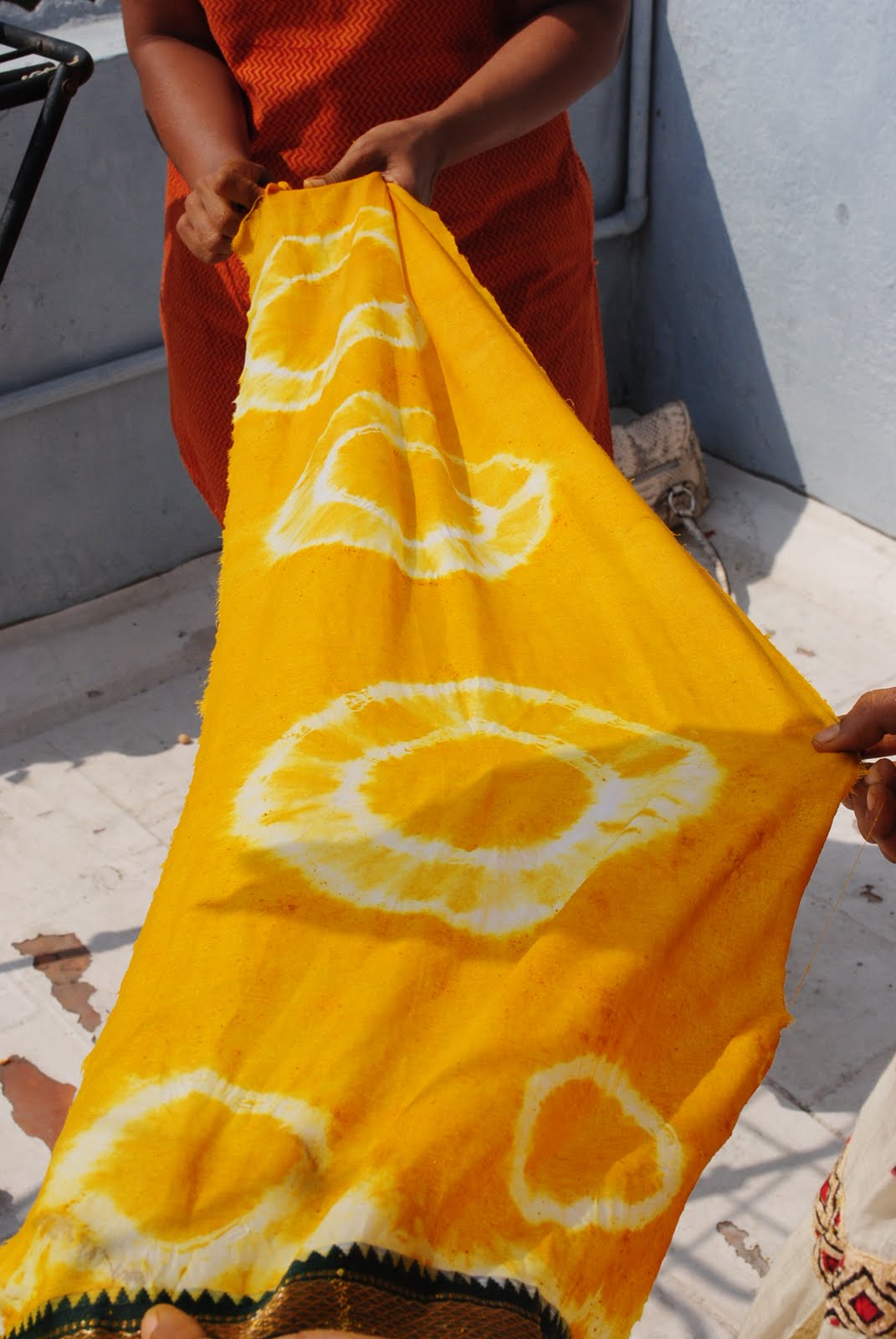
probably the easiest of all the dyes is turmeric. especially in india, where it is so abundant. turmeric is one of the few dyes that you can prepare in a cold bath - no energy is needed to heat the dye stuff. we simply put 100 grams of turmeric powder in this bucket of cold water. used rubber bands to create resist patterns and then dropped our cloth inside. we left our fabric overnight, just to soak in the color. no mordant used on this cotton, which was actually an old veshti!

Monday, January 24, 2011

curry leaves and turmeric: a very indian natural dye


today i finally got my hands into some natural dye work. i thought i would try using curry leaves, as we have an abundance of them growing at home amended with several left over stems from the market. the curry plant is native to india and is a tree Murraya koenigii. it is a mainstay of south indian cooking flavoring rasam, sambar, pooriyal, pongal, etc... etc.. etc...

this was my first test dye in india, so i was a little nervous not having my usual tools with me.
i am in chidambaram and didn't quite know how to procure alum, the mordant i most commonly use for cotton, so instead i tested out giving the cloth a nice soak in some warm salt water. i found a beautiful handwoven white towel for my experiment.

after soaking the fabric for a bit in the warm salt water i started boiling up a nice big bunch of dried curry leaves. i let the leaves boil over a low heat for about 40 minutes before adding my cloth. afterwards i let it boil for about 1 hour. the dye bath was a beautiful though faint golden copper color. just to give it a rich yellow tinge i decided to add one spoonful of turmeric powder. instantly the colors merged - i let it simmer for about 20 more minutes before removing it form the heat, rinsing my cloth and hanging it to dry!

beautiful colors from nature. just what i needed to get inspired and excited for this week's natural dye workshop that i am leading in chennai - hope to have goods pics from that to share.

thanks for visiting. d

Monday, January 17, 2011

Tulsi: Holy Basil

Our plant behind the house in Chidambaram

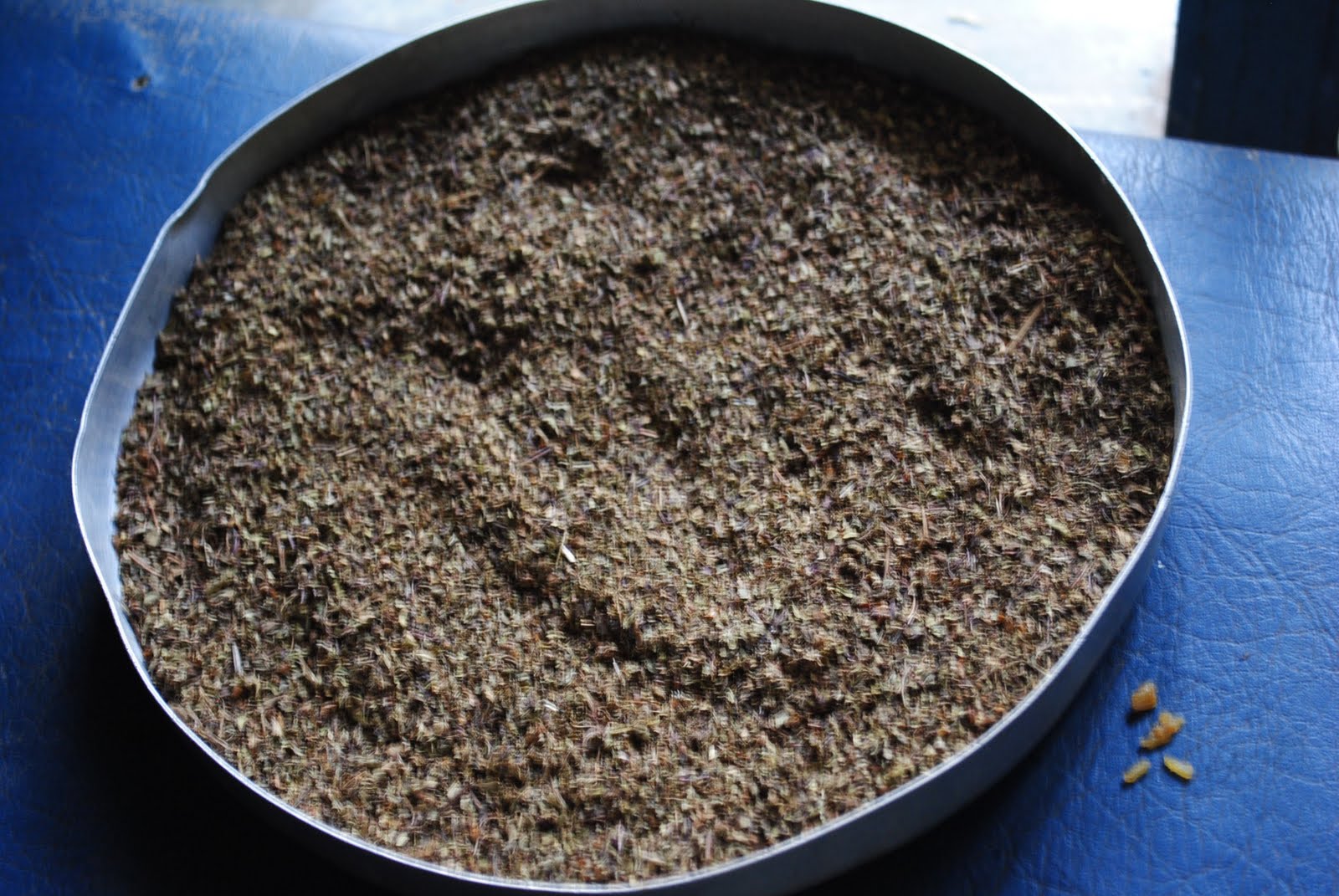
Dried Leaves for Tea


Many have heard of this wonder plant, sacred and useful, Tulsi: Ocimum sanctum (Syn. O. t

enuiflorum).

There are many varieties of Tulsi - a variety of basil, whose Genus itself has 40 odd varieties. The most common cultivars are Krishna, Vana and Rama and some say that it has been used for over 5000 years in India.


This plant is easy to grow in a warm climate. It is a perennial that reseeds itself in hot climates and can be grown as a summer annual in more temperate areas such as the Bay Area.


The plant, which some say to be a reincarnation of Krishna is adored and adorns many Indian households, most giving the plant a special alter style pot and offering flowers and other such puja items to the plant as they would other religious icons.


Tulsi is used as a immune booster, to fight off coughs and colds, for relaxation and stress-relief and as a digestive-aid.


You can eat a few fresh leaves a day, or add them to your water for fragrance. Or, most commonly, you can dry the leaves and prepare a tea. You can also infuse the leaves into honey to use.

Saturday, January 15, 2011

sugar cane - nature's candy

Saccharam sp. -- the plant we know and love for helping add a little sweetness to our lives. There are some 35 species of sugarcane, members of the grass family Poaceae. Sugar has an extremely long and not all that pleasant history, to read more on this topic I highly recommend Sidney Mintz's book " Sweetness and Power"

Here in Chidambaram, where sugarcane is cultuivated in all the surrounding fields along with paddy, the purple sugarcane is honored during the festivities of Pongal. After using them for the festivities, we get to cut open the stalks and chew on the yummy pith - savoring the sweet water within. Lining the streets here you will see vendors selling fresh sugar cane juice - I had once believed that they added water to the sugary nector, but no! The stalk contains so much water. We first split the cane, then skinned off the outer purple layer and cut the stalk in to small bits - just like candy. You chew the bits to release the yummy sweet liquid then spit out the fibrous remains. so sweet and tasty!

Friday, January 14, 2011

Pongal: A harvest Festival


Happy pongal from Chidambaram. Pongal is a harvest festival celebrating the abundance of crops and giving thanks to the sun god and cows for food and milk. Preparations for Pongal have been in full swing. Yesterday we headed to the market to get beautiful fresh purple sugar cane stalks to decorate our home with and eat after the festivities, fresh ginger and turmeric with their stems and leaves to use to prepare the pongal with. Pongal literally means to boil over, and in the morning on Pongal day, a dish called "chakara pongal" - a sweetened rice pudding is prepared, as the milk boils over the pot adorned with the turmeric and ginger leaves, we chant " pongal - o - pongal" boil boil!

special kolams are made to decorate the outside of the house.

a simple recipe for my version of chakara pongal:

Ingredients:
handful of cashews
1 tsp. freshly ground cardamom powder
1 tbsp. jaggery
1/2 cup rice
2 cups milk
ghee

1. heat the ghee in a pot and add the cashews, once browned add the rice and saute a bit until ric is clear
2. add the jaggery, milk and cardamom
3. stir constantly to avoid the bottom from burning
4. chant pongal - o-pongal!
5. enjoy

HAPPY PONGAL


Friday, January 7, 2011

coconut water and palm fruits


one of the things i enjoy most about being in india is definitely the fruits. the top photo is of palm fruits - called "nongu" in tamil. it's squishy inside is like a lychee.

below is an all time favorite - although i have to confess that when i was younger i had a serious aversion to it, it is "eleneer" or tender coconut water. this has to be the most refreshing, rehydrating beverage. and the beauty of being in india is that one can have one every day. when finished with the water you can crack the whole thing open to eat the yummy "meat" inside.

Wednesday, January 5, 2011


while in coimbature, i had lots of time to take walks and simply admire the nature around us. there were so many lovely flowers and i appreciated nature's beauty. each flower, so different, in color, size, shape and form, each complicated, yet meant to perform the same simple function. each with a beautiful fragrance and ephemeral glow. i reflected on our own ability and blessing to blossom, each day, over time.

i was especially amazed by the bouganvilla- a common plant, whose colorful brachts (the pink parts are not flowers, but modified leaves that attract pollinators to the tiny white flowers within) are abundant and even adorned our little cottage back in berkeley, but this variety was cauliflorous - it's flowers emerging right from the stem.

the beautiful yellow queen (Pachystachys lutea) and the white spider lily (Hymenocallis narcissiflora) were taken at the new botanical park in chennai.

everywhere around us is beauty, in nature and each other. take a moment to enjoy and appreciate.

Wednesday, December 29, 2010

tiffin carriers


going to pondy bazaar in the t.nagar neighborhood of chennai is like walking through a maze of everything and anything you ever wanted. that is if all you ever wanted were cloths, shoes, plastic buckets, sticker bindis, hair pins, safety pins, sweets of all kinds, fresh flowers and fruits, street foods, saris jewellry and of course "ever silver" - the name that a certain type of metal is referred to. we stepped into Rathna stores to buy some thali plates - the ones that have seperate compartments for each dish and i was just amazing by the quantities of items they had. my favorite area was where the tiffin carriers were. tiffin carriers are perfectly designed containers for storing all you need for "meals" - rice, sambhar, rasam, a kuttu and a curry, curd, pickle and appalam.

Monday, December 27, 2010

fabric flowers


i love being send on a mission. my sister, who is getting married in august, is making fabric hair clips and boutonierres for all her guests, so she's asked me to pick up a variety of fabrics here in india for her project. luckily i stumbled upon dastkar andhra's exhibition which is running now in chennai. they are an ngo that works on preserving natural dye traditions as well as handloom fabrics. i ammended my purchases there with some lovely silks from RaSi, a mylapore insitution next to the Kabbali Koil. using the inspiration board she gave me i selected a number of fabrics. i had a lovely assortment of green shades for the leafs, but unfortunately they got sent back to the US with my mom! maybe we'll get a photo of them soon to post.